


- 7 min read
- Updated
- Supports: Entry Doors
Front Entry Door Buying Guide: Build Your Project Brief
You do not need to choose every front-door detail before speaking with a provider. You do need a way to keep decisions, evidence, and unanswered questions together. Use this buying guide to build one project brief that can travel from your first inquiry to the final order review. It supports our front entry door replacement service.
Work through the records below in sequence. Keep a question open when the answer is unknown; avoid letting an assumption become an approved selection.
The short version
To buy a front door, rank your needs as essential, preferred or optional, shortlist two complete door options, and compare quotes on the same baseline. Settle lock compatibility, glass, finish and measurements before you order.
On this page
1. Create one project card
Begin with a short record of the entrance and the reason for the project. Add photographs from inside and outside, including the full frame, floor transition, porch, nearby fixtures, and any sidelights or transom.
| Record | What to write |
|---|---|
| Main problem | The condition or experience you want to change |
| Desired result | What a successful replacement would let you do or enjoy |
| Opening plan | Keep the opening, consider a change, or undecided |
| Related work | Planned flooring, painting, porch or wall changes |
| Timing constraint | An actual household deadline and why it matters |
| Known documents | Existing product information and relevant property requirements |
Keep observations separate from diagnoses. “The door catches near the floor” is a useful observation. It does not establish which component has failed. Approximate dimensions can describe the project, but label their reference points and leave ordering dimensions to the responsible professional.
Before moving on: Make sure the desired result is clearer than “a better door.” One concrete goal gives the remaining choices a useful test.
2. Rank requirements before collecting designs
Divide your priorities into three groups: essential, preferred, and optional. Limit the essential group to requirements that would cause you to reject an otherwise attractive proposal. These might concern usable access, a fixed opening, a specific privacy need, or compatibility with a planned renovation.
For a hypothetical household, preserving the current opening could be essential, a painted finish preferred, and decorative glazing optional. Another household may treat daylight as essential and remain flexible about the surface material, which our comparison of entry door materials can help narrow. Neither list is a universal recommendation.
Ask other regular users to review the ranking. A household member who struggles with a handle motion may reveal a requirement missing from the inspiration images.
Pause here if: Two essentials conflict. Record the conflict and ask the provider what alternatives could resolve it before treating either feature as settled.
3. Shortlist two complete entrance concepts
Choose two configurations worth investigating rather than collecting an unlimited gallery. Describe each as a complete entrance: operating arrangement, daily passage, glass location, broad surface preference, and surrounding frame composition.
Draw or mark the movement on a simple plan. Include the place where someone stands while opening the door and nearby furniture or porch obstructions. For paired doors or pivot entry doors, request the actual daily operating sequence and clear passage before accepting the concept.
For each candidate, write one sentence explaining why it meets the essential requirements and one unresolved question. A candidate with no clear benefit over the other may not need a separate quote.
Before moving on: Ask whether both concepts are available and suitable for the application. An inspiration photograph remains an idea until an actual assembly supports it, which matters most for custom front door designs.
4. Keep a sample and appearance log
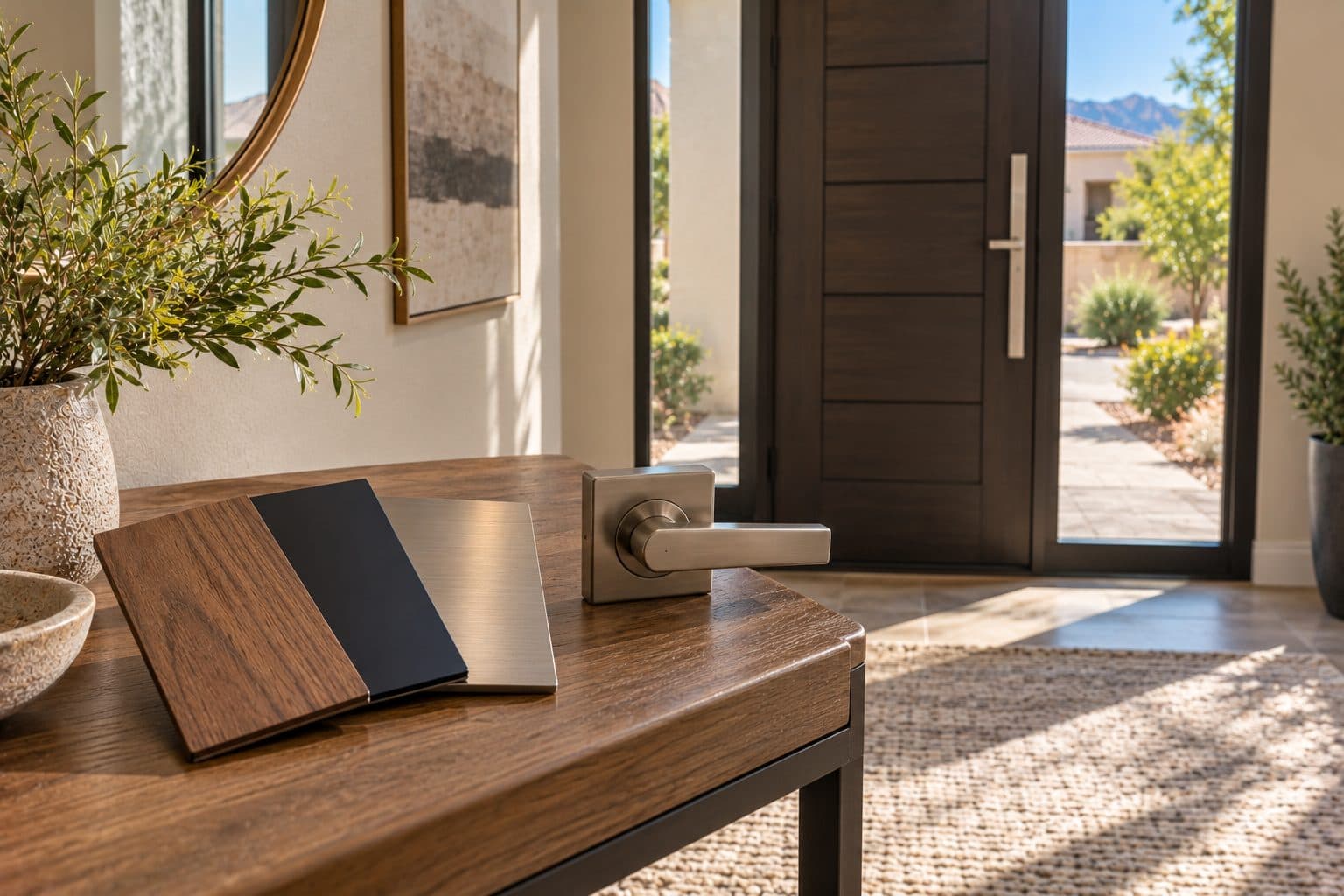
Give each proposed finish and glass selection a recognizable name or reference. Photograph physical samples beside the existing wall or trim, while remembering that a photograph cannot reproduce appearance perfectly.
| Selection | Record before approval |
|---|---|
| Surface and finish | Product reference, texture, color, sheen and delivery condition |
| Visible wood | Sample identity and agreed expectations for natural variation |
| Glass | Exact design, clearer areas and privacy questions |
| Hardware appearance | Finish, shape and relationship to the door pattern |
Evaluate glass from the approach as well as inside. The glass entry door options page describes the common glazed layouts. If night privacy matters, ask how the actual selection behaves with the foyer lit. Record whether a compatible covering is part of the intended result.
Pause here if: Approval depends on a tiny online swatch, an unnamed sample, or an assumption about privacy. Request the missing reference before accepting the appearance.
how we install
The Part Behind the Glass

Measured before anything is ordered

Hung, aligned and latched
5. Collect the compatibility answers
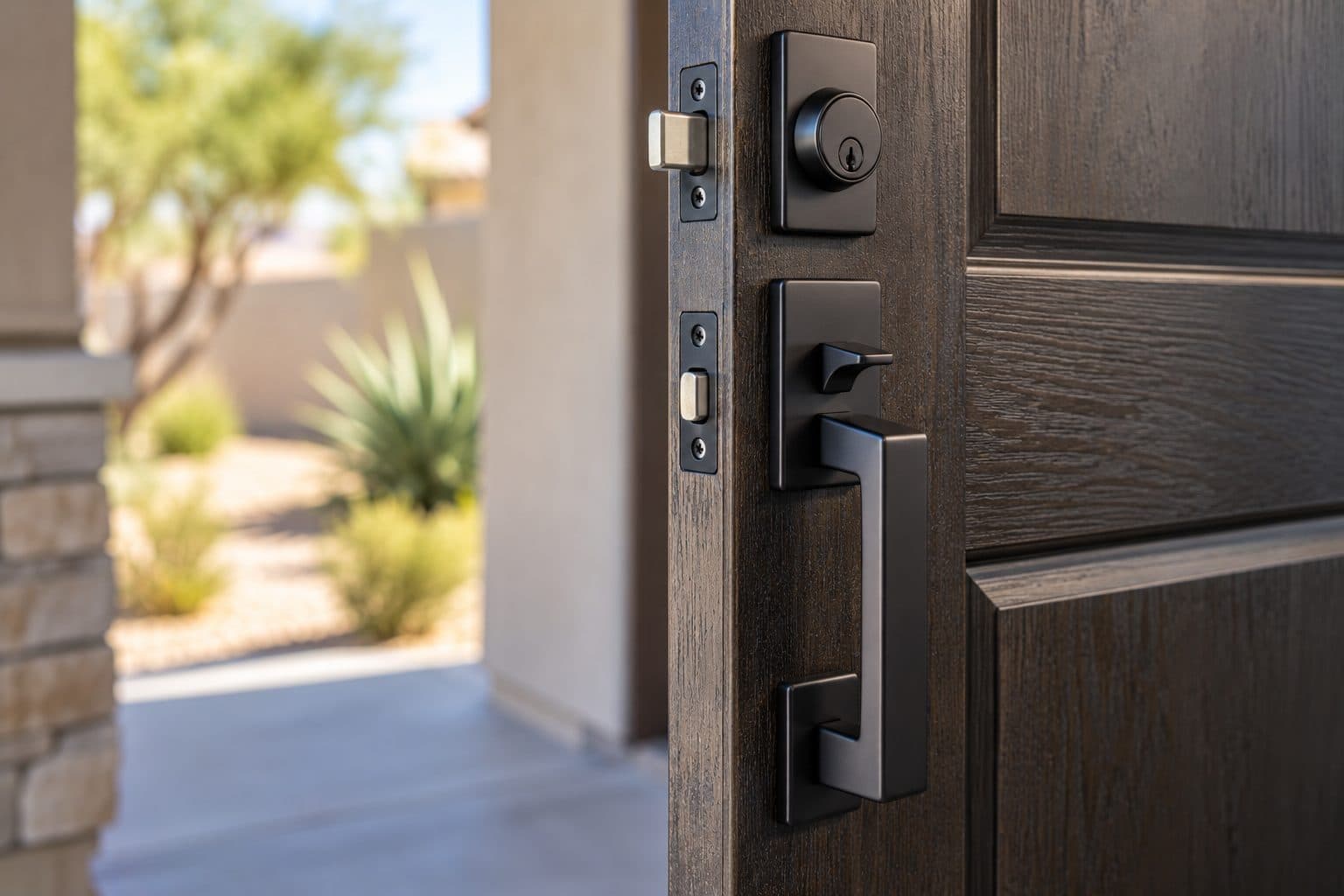
Create a short questions list for the supplier or installer. Include any existing lock you want to reuse, electronic access device, unusual handle, covering, or other door hardware choice that affects preparation. Use exact model information where available.
Add the questions raised by the entrance exposure and selected material. Ask for the relevant exterior-use, finishing, and care instructions. If performance is important, request documentation tied to the proposed assembly, including its glazing and configuration.
Mark each answer as documented, awaiting confirmation, or no longer needed. A verbal possibility is useful during exploration, but it should not silently become a confirmed order feature.
Before moving on: Every essential feature should have a supported answer or an explicit plan for resolution. If a feature is unavailable, revise the shortlist or the priorities openly.
6. Compare quotes using one shared baseline
Send the same project card and requirements to each provider. Ask for a clearly identified baseline and separately described options. When size, glass, hardware, and installation scope all change at once, the totals are difficult to compare.
Record the exact assembly, finish, glass, hardware, retained components, and work included around the opening. For each difference between proposals, write whether it changes a requirement, an optional feature, or the work someone else must perform.
Keep allowances, exclusions, and unanswered conditions visible. Ask who performs excluded work and how unresolved amounts will be confirmed. Review actual product and installation coverage documents alongside the scope.
Pause here if: One proposal cannot be matched to the agreed baseline. Resolve the difference before choosing on price. The entry door replacement cost guide explains how scope changes a quote; this record keeps your comparison consistent.
7. Clear the questions that could change the order
Make a final open-items list with a responsible person and the evidence needed. A question is not closed merely because someone has discussed it; the answer should appear in the current selection or scope record.
| Open item | Who provides the answer | What closes it |
|---|---|---|
| Final unit dimensions | Professional responsible for measuring and supply | Matching current drawing and order dimensions |
| Reused lock compatibility | Relevant supplier or hardware provider | Confirmation of the exact model and preparation |
| New floor height | Party responsible for the finished floor, coordinated with door installer | Agreed final level in the threshold detail |
| Privacy at night | Homeowner with the supplier's actual sample information | Accepted glass or covering selection and recorded limitations |
| Required property approval | Assigned applicant and relevant reviewer | Applicable approval or documented determination |
The roles are examples to assign in your project, not a statement that Agave supplies every service. Homeowner approval of appearance should remain separate from professional responsibility for dimensions, structural design or required compliance.
Ask which unresolved items can change the product, preparation or work before manufacture. Those items need resolution in the agreed release sequence. A later appointment preference may be a legitimate scheduling detail; an unknown lock preparation is part of the product itself.
For a hypothetical project with new foyer tile, a flooring choice may look cosmetic while changing the final level at the door. Record the selected thickness and have the responsible parties coordinate the threshold before treating the opening dimensions as final. The worksheet exposes that dependency without asking the homeowner to design the sill.
For every resolved item, update the actual selection record. If a change affects the other candidate, finish sample or price, request a coordinated revision. Keep older documents clearly marked as superseded.
Before moving on: You should be able to identify the current drawing, current proposal and remaining responsibilities without piecing together contradictory messages.
Check one requirement all the way through the records
Choose an essential requirement and trace it from the project card to the selected option and final proposal. For example, a requirement for night privacy should appear in the glass or covering choice and its sample reference. It should not disappear after the decision becomes a color-and-price comparison.
Repeat this for each essential. If a requirement has no corresponding selection or documented answer, keep it open. This short trace check is more useful than accumulating additional brochures because it verifies that the proposed entrance still solves the original problem.
8. Approve one identifiable version
Review the final proposal and drawings together. Check the viewing side, movement, dimensions supplied by the responsible professional, glass, finish, hardware, and any agreed preparation. Confirm that the selected version meets the essential requirements recorded at the start.
Ask how later changes are handled before approving the order. Save the agreed revision and keep product identification, care information, and coverage documents with it as they become available.
Your finished brief is now useful to both you and the provider: it explains the goal, the chosen entrance, why alternatives were set aside, and what was approved. Bring the project card to Agave Windows and request a front door estimate when you are ready to begin that conversation.
This guide supports
Entry Doors →things people ask us
Frequently Asked Questions
Can I request an estimate before completing the worksheet?
Yes. The project card, photographs, and ranked priorities are enough to begin a useful conversation. Leave technical questions open for the responsible provider. The later records help you organize answers as the selection develops; they are not a requirement to arrive with a finished design or your own manufacturing dimensions.
What if I prefer different features from two quotes?
Ask for a revised proposal that combines only compatible, available features and identifies the resulting assembly and scope. Do not create an informal hybrid order by assuming separate quoted components fit together. Recheck the essential requirements, samples, documentation, and price after the revision so the approved version is coherent.
How do I know an unanswered question should delay approval?
Ask the provider whether the answer could change the product, dimensions, preparation, exterior design, or required work before manufacture. Record who resolves it and what evidence closes it. A missing finish choice or hardware compatibility answer is different from a later scheduling detail. The responsible professional should identify the appropriate release conditions.
Still have a question about your home?
Ask us directly. A quick description of the opening is enough.
keep going
Related Services and Guides
- Entry Doors
Front door replacement in Las Vegas: decide between a new door slab or a full frame, pick glass and hardware, and know what to check when it is installed.
- Compare entry door materials
Fiberglass vs steel vs wood entry doors: how the three materials compare on looks, upkeep, sun exposure and security, and how to choose for your entrance.
- Plan the entry door budget
What drives front door replacement cost in Las Vegas: slab or full framed unit, material, sidelights, hardware and finish work. See what to compare.
- Understand custom front-door design
Custom front doors in Las Vegas: when you need true custom work, how drawings and samples settle the design, and who handles measuring and hardware.
- Explore glazed entry options
Glass entry doors in Las Vegas bring daylight into the foyer. Compare clear, textured and decorative glass, sidelights, transoms and privacy at night.

ready when you are
Have a Question About Your Own Home?
A guide can explain the choice. Your openings decide the answer. Tell us what you are seeing and we will help you work out the next step.
- Photos can follow once we reply; no measurements needed
- A written scope before anything is ordered
- Licensed, insured, and bonded
Request an Estimate