




- 7 min read
- Updated
- Supports: Sliding Glass Doors
When Should You Replace a Sliding Glass Door?
A sliding glass door does not need complete replacement merely because one component has a problem. The right scope depends on what has failed, the condition of the rest of the assembly, whether suitable parts are available, and what you want the opening to do.
Start with a condition assessment. Then compare repair, component replacement, and a new door as different ways to address the actual problem. Age alone is not a diagnosis.
The short version
Replace a sliding glass door when the frame or track is damaged, parts are unavailable, or the layout no longer works. A dragging panel or fogged glass can often be repaired, and age alone is not a reason.
On this page
Separate the symptom from the replacement decision
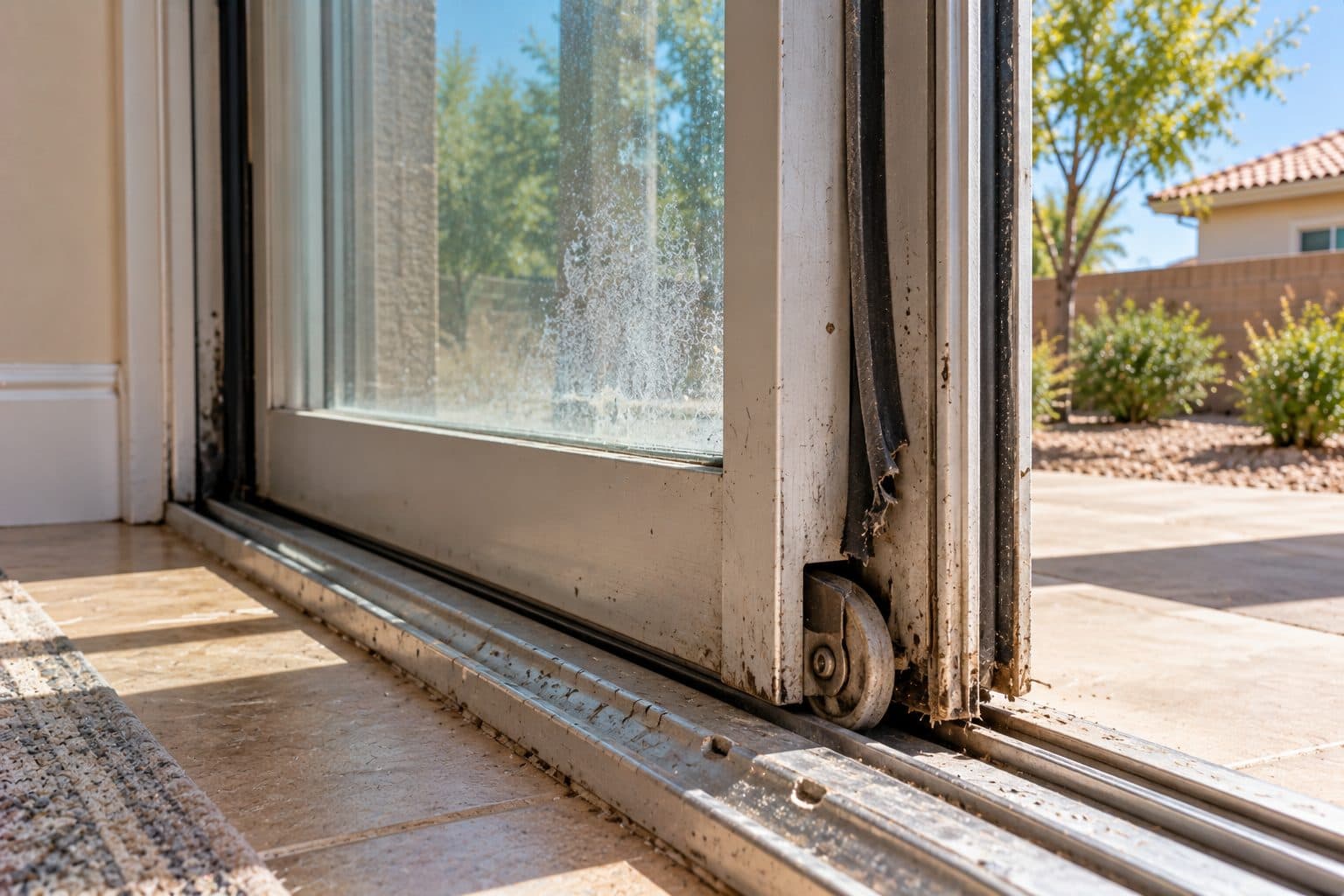
Record what happens and when. Does the panel drag throughout its travel or catch in one place? (Our guide explains why a slider becomes hard to open.) Does it close but fail to latch? Is moisture on a reachable glass surface or trapped between sealed panes? Has water appeared at the floor during weather?
Those observations help direct inspection, but they do not prove a cause. A door may have more than one issue, and a visible symptom can originate in the surrounding opening. Avoid deciding on a complete replacement before understanding what the proposed work would solve.
Photographs, a short operation video taken from a safe position, and any available product identification can support the initial conversation. Do not force the door or remove a panel to collect information.
Address urgent conditions promptly
Broken or unstable glazing, a displaced panel, or an opening that cannot be secured requires appropriate professional attention. Restrict use where needed and keep people away from damaged components. A heavy sliding assembly should not be treated as a casual adjustment project.
These conditions do not automatically determine the final replacement scope. An assessment may identify a suitable component solution or establish that broader work is necessary. The immediate goal is to understand and manage the condition safely.
Keep the household's usable exit routes in mind. A patio door that has become difficult to open deserves attention beyond its inconvenience, especially if it is part of the normal route outside.
Consider repair when the problem is localized
A worn or damaged operating component may be a candidate for sliding glass door repair when the surrounding assembly is sound and compatible parts can be obtained. The evaluation should establish the condition of the panel, track, frame, and locking arrangement rather than assume a single replacement part will resolve everything.
Ask what the repair is expected to correct and what it leaves unchanged. Repairing operation will not necessarily alter glass performance, sightlines, threshold design, or the location of the daily passage. That may be perfectly acceptable if those features already suit the home.
Request the repair scope and any limitations in writing. Part availability, existing damage, and product support matter to the decision. Repeated unsuccessful adjustments deserve a broader assessment rather than an indefinite sequence of the same attempted fix.
Treat a glass problem as its own question
Persistent moisture between sealed panes can indicate a problem with the insulated glass unit. Moisture on an accessible interior or exterior surface is a different condition. Establish where the moisture is before using fogging as a reason to replace the complete door. Our guide to where condensation forms explains the difference.
Depending on the assembly, suitable glass or panel replacement may be possible while retaining other components. Ask whether the existing frame and operating system are sound and whether a matching, appropriate replacement component is available.
A new glass unit will not correct a damaged track, failing frame, or unsuitable opening. Conversely, replacing the entire door may be unnecessary when the glass is the only issue and the rest of the system remains appropriate. Compare the actual scopes.
how we install
The Part Behind the Glass

Measured before anything is ordered
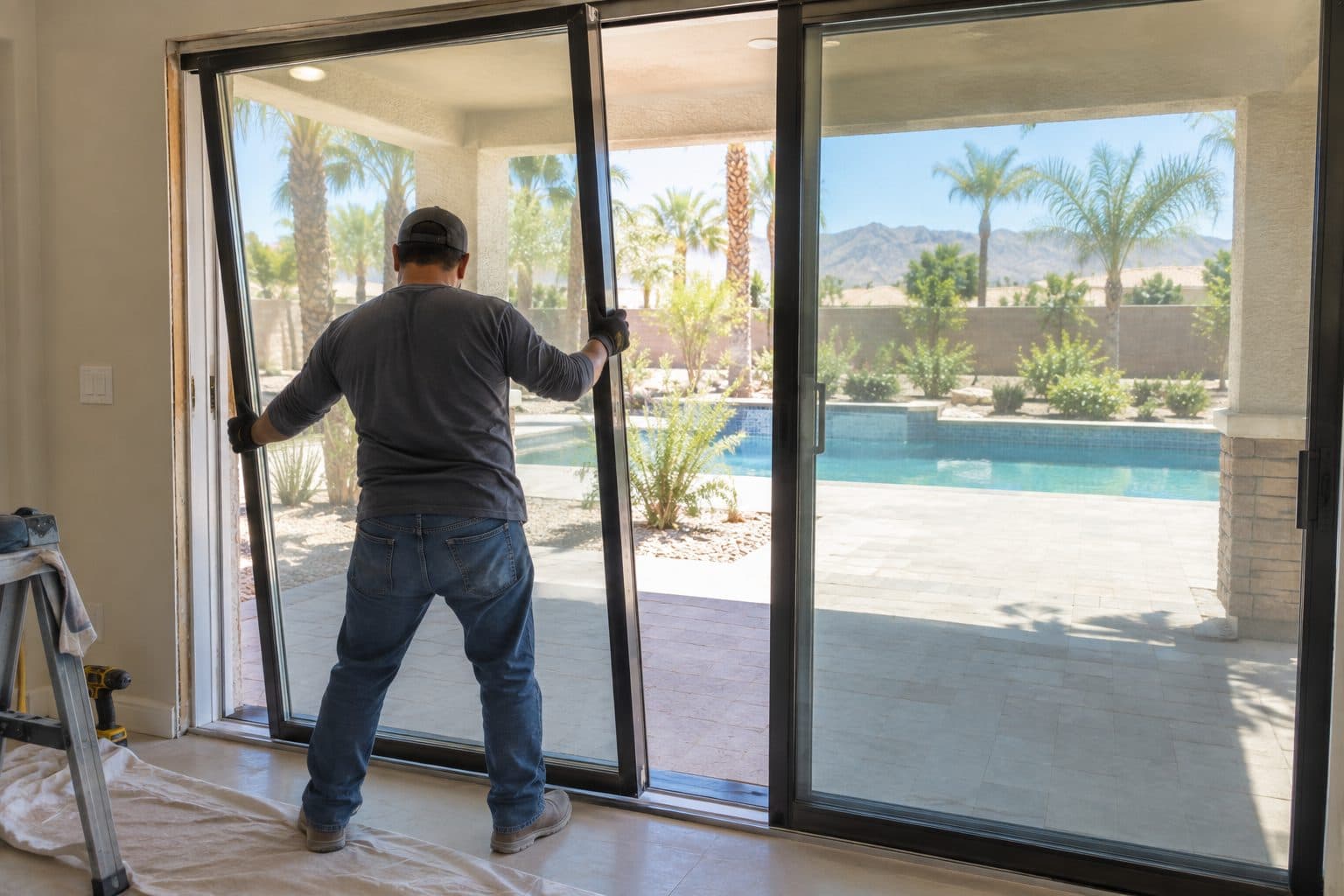
Panels set and adjusted
Look beyond the moving panel
Frame deterioration, damaged supporting surfaces, persistent alignment problems, or an unsuitable threshold can make a replacement sliding glass door more relevant. The condition of the surrounding wall also matters. Staining and water at the opening should be investigated rather than covered by new trim without explanation.
Replacement should include a plan for the interface between the new assembly and the wall. Support, flashing, sealing, and drainage need to suit the product and existing conditions. A new door alone does not establish that a separate water path has been resolved.
Ask whether the proposed installation retains any part of the old assembly and why that part is suitable. A clear explanation of what remains is essential to understanding what replacement will actually change.
Decide whether the layout still works
Sometimes the door functions, but its arrangement no longer serves the household. The active passage may sit behind furniture, the clear opening may be inconvenient, or the screen and handle may be uncomfortable to use. Those are legitimate design reasons to explore replacement.
Separate a same-opening replacement from changing the wall. A different operating direction or assembly may be possible within the current opening, while enlargement introduces construction and approval questions. Do not allow a product selection to hide that difference in scope.
If the goal is a different door family, compare its movement and storage before deciding. Hinged, folding, and multi-slide systems can solve different layout needs and bring different preparation requirements, which the patio door buying guide helps you compare.
Compare what each scope solves and leaves behind
A useful proposal names the defect being addressed and the components that will remain. Repair, glass replacement and complete door replacement may all be reasonable in different circumstances, but they do not promise the same changes.
| Scope under consideration | Evidence supporting consideration | What still needs a separate answer |
|---|---|---|
| Operating-component repair | Identified compatible part and otherwise suitable assembly | Condition of retained glass, frame and supporting opening |
| Glass or panel replacement | Confirmed glass concern and an appropriate replacement component | Operation, seals and frame condition outside that component |
| Complete door replacement | Broader deterioration or a documented need for a different assembly | Any damage or water path beyond the removal boundary |
| Door plus opening repairs | Identified supporting-surface or wall-interface problem | Defined construction scope and responsibility for each interface |
Ask each proposal to state the expected result, retained components and unresolved conditions. If an option leaves an essential problem unanswered, do not mark that problem solved merely because the price is attractive.
Compare costs only after these boundaries are clear, using the patio door replacement cost guide to line up the scopes. Include diagnosis, compatible parts, installation, finishing and any required adjacent work in the appropriate scope. There is no universal repair-cost percentage or age cutoff that makes this decision for every entrance.
Use the same symptom to test different decisions
Consider two hypothetical doors that are difficult to slide. For the first, an assessment identifies a replaceable operating component, a sound frame and a layout the household likes. A documented repair may address the actual need while retaining suitable parts.
For the second, assessment finds operating damage together with an unsuitable supporting surface and an unresolved water path at the wall. Replacing one moving part would leave the broader condition unanswered. Even a new door needs a scope that addresses the relevant opening work. The symptom sounds similar; the evidence leads to a different boundary for the project.
The same reasoning applies to cloudy glass. Pella's condensation guidance distinguishes roomside or outside moisture from moisture within the sealed space. Once that location is established, assess the rest of the door separately. A glass condition does not automatically demonstrate that the track, frame or layout has become unsuitable.
These examples are decision patterns, not remote diagnoses. Their purpose is to show which findings change the choice and why one symptom should not automatically trigger a complete replacement.
Resolve the uncertainty that could change the scope
Before choosing, identify the unanswered question that could most change the recommendation. It might be whether a compatible part exists, whether a retained frame is sound or whether water arrives through the door or from the surrounding wall. Obtain the relevant assessment rather than accumulating estimates that repeat the same uncertainty.
For moisture concerns, the installation boundary matters. PNNL's flashing guidance explains how openings relate to the wall's drainage layer. That is why a promise to replace the unit should not stand in for identifying a separate wall-water issue.
If a repair is chosen, record the operating problem it is intended to resolve and what follow-up is appropriate if that symptom remains. If replacement is chosen, record the specific reasons a new assembly is valuable and any surrounding work required. This makes the recommendation reviewable without pretending every concealed condition is known in advance.
Set realistic performance expectations
If comfort, noise, or solar heat is part of the replacement goal, request evidence for the selected assembly. Whole-product ratings and the actual installation matter. Do not assume a new door will eliminate all sound, drafts, or room-temperature differences.
Describe the problem precisely so the proposal can address it. Glare at a particular hour, air leakage around a patio door seal, and a difficult-to-open panel are separate observations. They may require different product or installation decisions.
Bring Agave Windows photographs, product information if available, and your priorities when you request a sliding door estimate. The useful next step is a scope based on the condition and intended result, with repair alternatives considered where appropriate.
This guide supports
Sliding Glass Doors →things people ask us
Frequently Asked Questions
Does a hard-to-open slider always need replacement?
No. The cause may be a localized component issue or a broader problem with the panel, track, frame, or opening. An assessment should determine the cause and whether compatible repair is practical. Avoid forcing the door or assuming a roller adjustment will solve every condition. Replacement becomes one option after the condition and goals are understood.
Does fog between panes mean the whole door is failing?
It can point to an insulated-glass issue, but it does not by itself establish the condition of the frame or operating hardware. Confirm that the moisture is actually between sealed panes. Ask whether suitable glass or panel replacement is possible and assess the remaining assembly separately before choosing the extent of work.
Should I replace a door simply because it is old?
Age can help identify the product and available support, but it is not a complete decision rule. Condition, operation, part availability, opening integrity, and your desired improvements matter. A sound older assembly with a localized repair need is a different situation from one with extensive damage or an unsuitable layout. Compare the actual options rather than an arbitrary age cutoff.
Still have a question about your home?
Ask us directly. A quick description of the opening is enough.
keep going
Related Services and Guides
- Sliding Glass Doors
Sliding glass doors in Las Vegas: choose which panel opens, how wide the walkway is, and the right glass, screen and threshold for your patio opening.
- Why a slider becomes hard to open
Why is your sliding glass door hard to open? Common causes include a dirty track, worn rollers and misalignment. Learn what to check and what to avoid.
- Understand air leakage around patio doors
Why patio doors leak air: worn seals, panels out of alignment, the threshold, or the gap around the frame. Learn how to find the draft and what fixes it.
- Identify where condensation forms
Window condensation guide: what moisture on the inside, on the outside, or between the panes means, and when a wet window needs service.
- Explore sliding-door repair assessment
Sliding glass door repair in Las Vegas for doors that drag, close unevenly or will not latch. See how rollers, track and locks are checked together.
- Plan patio replacement costs
What affects patio door replacement cost in Las Vegas: door type, glass, threshold changes and finish repairs. See how to compare quotes line by line.
- Patio Door Buying Guide
A patio door buying guide: write a short brief, rule out layouts that do not fit, test the everyday trip outside, then compare quotes on the same scope.
- Sliding Glass Doors vs French Doors
Sliding glass doors vs French doors: compare floor space, walk-through width, screens and everyday use to pick the right patio door for your room.
- Bifold vs Multi-Slide Doors
Bifold vs multi-slide doors: see how each stores its panels, how wide the opening really is, daily access and threshold needs before you choose.
- Bifold Door Cost
What affects bifold door cost in Las Vegas: panel count and layout, sill type, glass, finishes and any structural work. Learn how to compare quotes fairly.
- Multi-Slide Door Cost
What affects multi-slide door cost in Las Vegas: stacking or pocket panels, track and floor transition, glass and wall construction. See what to compare.
- Sliding Glass Door Size Guide
Sliding glass door size guide: the difference between frame size, rough opening, clear opening and visible glass, and what to measure before an estimate.
Sources referenced on this page
Independent references linked in the text above. A manufacturer source explains a product concept; it does not mean Agave Windows supplies that brand.
- Pella's condensation guidance (pella.com)
- PNNL's flashing guidance (basc.pnnl.gov)

ready when you are
Have a Question About Your Own Home?
A guide can explain the choice. Your openings decide the answer. Tell us what you are seeing and we will help you work out the next step.
- Photos can follow once we reply; no measurements needed
- A written scope before anything is ordered
- Licensed, insured, and bonded
Request an Estimate