


- 7 min read
- Updated
- Supports: Patio Doors
Patio Door Security: Features, Condition, and Safe Use
Patio-door security is a whole-opening question. The door, frame, glazing, hardware, installation, and the way the household uses the entrance all matter. Start by checking whether the existing assembly closes and locks as intended, then evaluate any proposed upgrades against the actual product.
This guide helps organize that assessment for any of the patio door types we replace. It does not rank every door family or promise that a particular material, lock, or glass treatment prevents entry.

The short version
Start by making sure the patio door closes, latches and locks properly, because worn parts undermine any upgrade. Then consider added locks, laminated glass and sensors, while keeping the door usable as an emergency exit.
On this page
Start with condition and ordinary operation
Notice whether the door closes fully, whether the latch engages normally, and whether a handle or strike is visibly loose. A panel that requires lifting or slamming to secure is a reason to arrange assessment. A locking device cannot be evaluated properly when the assembly is not aligned or operating as intended.
Describe the symptom without forcing a diagnosis. A sliding panel that binds, a hinged leaf that rubs, and a lock that moves without engaging can involve different causes. Our guide to hard-to-open sliding glass doors covers the first of these. Do not remove a heavy panel or dismantle hardware simply to investigate it yourself.
If damaged glass, a displaced panel, or an inability to secure the opening creates an immediate concern, restrict use and seek appropriate professional assistance. Product selection can follow once the immediate condition is understood.
Identify the complete assembly
Find the manufacturer and product information where it is readily available. A visible label, original invoice, or installation document can help identify compatible parts. Similar-looking handles or frames do not prove two assemblies use the same components.
For a replacement, ask the proposal to name the exact door, configuration, glazing, hardware, and relevant tested performance. A collection name alone may cover several assemblies with different options.
| Item to review | Useful question |
|---|---|
| Locking hardware | What is the normal locking sequence for this assembly? |
| Frame and support | How is the installed system supported and secured as specified? |
| Glazing | Which documented glazing properties are being claimed? |
| Supplemental device | Is it compatible and appropriate for the required exit operation? |
| Electronic feature | Does it monitor, control a lock, or perform another defined function? |
Keep the answers product-specific. A general description of a security feature is not proof that it is included or suitable for your door.
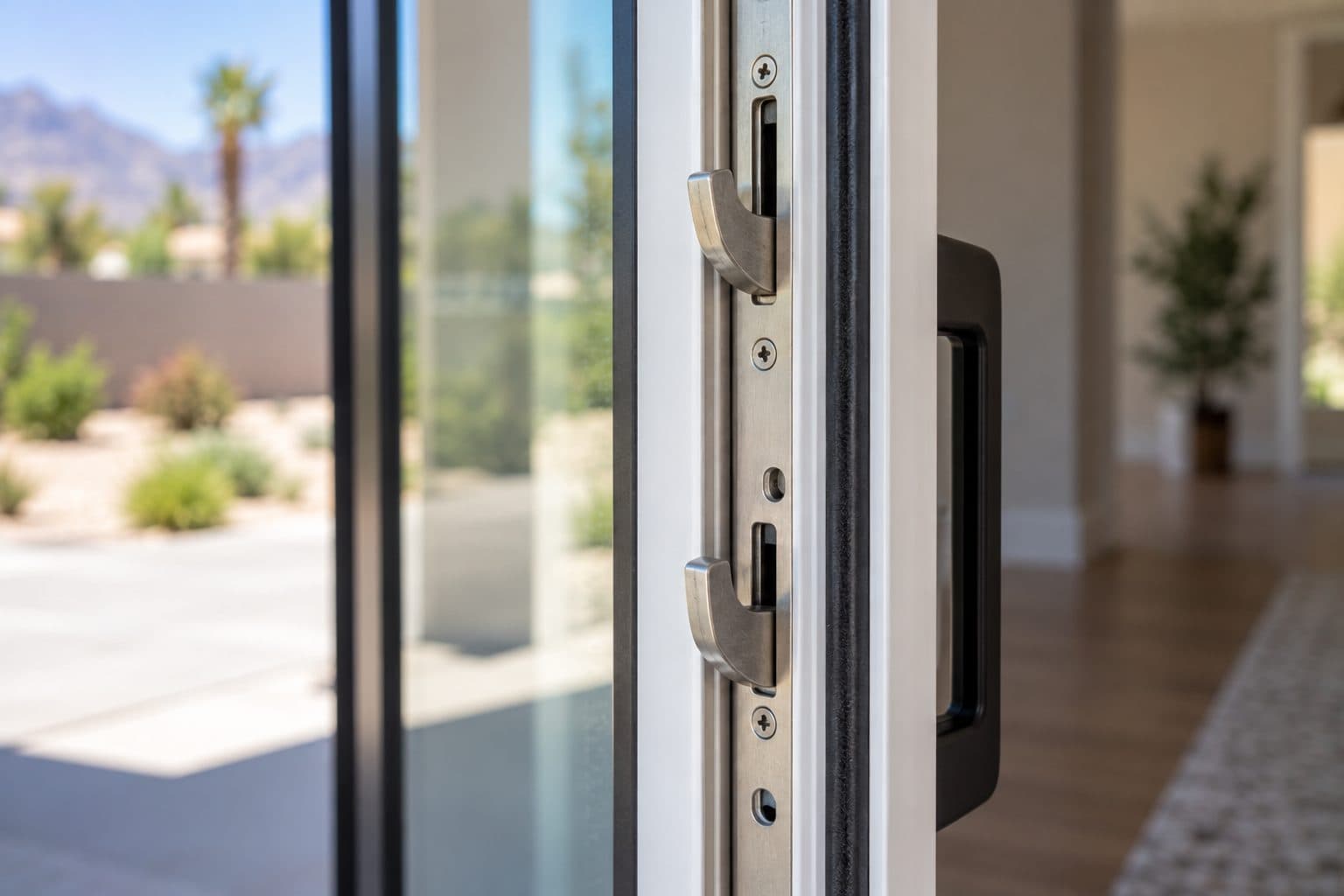
Understand the locking sequence
Sliding glass doors, hinged French patio doors, folding systems, and multi-slide doors can have different hardware arrangements. A paired assembly may require securing a secondary leaf before the active leaf locks properly. A multipoint mechanism may use a particular handle movement.
Ask for a demonstration and the written instructions. Regular users should know how to confirm the door is secured without guessing from handle position alone. Practice the normal sequence with the installer or service provider.
Changes in operation deserve attention. A lock that once engaged comfortably but now requires force may indicate a component or alignment issue. Do not assume stronger pressure is the intended solution or that adding another device makes the original condition irrelevant.
Evaluate supplemental hardware for compatibility
Auxiliary locks and other devices may be available for particular assemblies, and our design center page on door hardware options describes the main types. Ask whether the manufacturer supports the proposed addition and how it should be installed. The attachment location, frame construction, and intended operation matter.
Avoid choosing an accessory solely because its package says patio door. A device suitable for one slider may not fit another, and a hinged or multi-panel system may need a different approach. Drilling or altering the assembly without review can affect operation and coverage.
Discuss who will install the device and how all household members will use it. The aim is a coordinated locking arrangement, with the safe exit route considered at the same time.
how we install
The Part Behind the Glass

Measured before anything is ordered
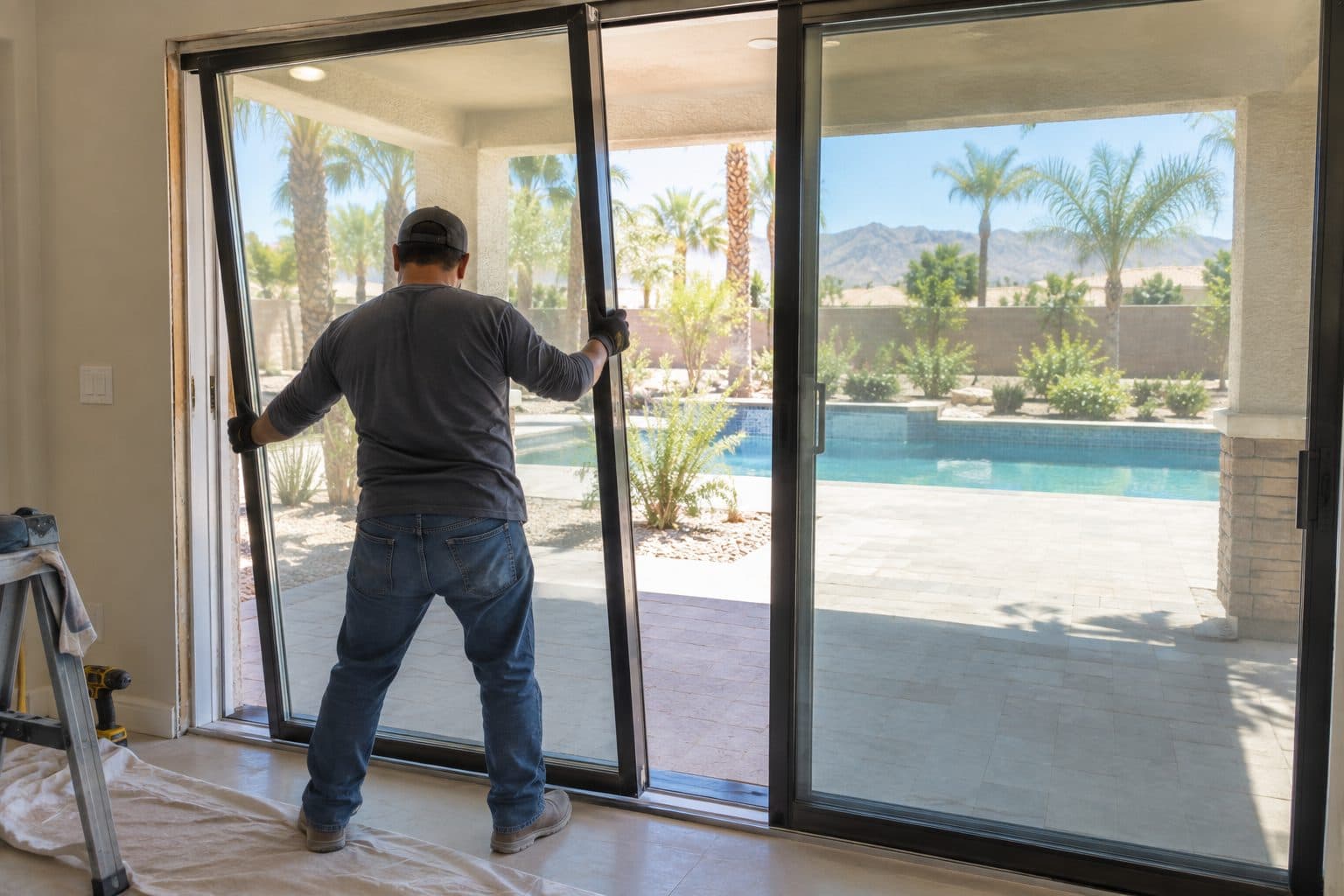
Panels set and adjusted
Preserve a usable exit
Security planning should include the household escape plan. Keep routes to doors and windows clear and make sure people know how to unlock and open the relevant devices. The U.S. Fire Administration recommends keeping exits unblocked and practicing the home escape plan.
Assess any supplemental hardware against applicable project requirements with the appropriate professional. This guide does not provide a universal rule for every lock, property, or opening. Do not assume a device is suitable merely because it makes the door harder to open.
After a hardware change, update the household's understanding of the entrance. A feature that is unfamiliar to a visitor, child, or another resident may require particular attention in the practical plan for leaving the home.
Distinguish glazing properties
Safety glazing, privacy glazing, thermal glazing, and forced-entry resistance describe different subjects. Safety glazing requirements address specified injury risks from human contact with glass. They do not by themselves certify the complete door against intrusion.
If laminated glass, impact performance, or another protective feature is proposed, ask exactly what has been tested and under which conditions. The claim must apply to the selected glass and assembly. Do not substitute a general material description for that documentation.
Added films or treatments also require compatibility review. They should not be presented as making ordinary glass unbreakable. Ask for evidence, installation requirements, and any effect on the existing product before proceeding.
Know exactly which electronic state is reported
Separate three functions: sensing a panel's position, sensing a lock condition and moving a locking mechanism. A fourth function, detecting glass breakage, is different again. An app showing closed cannot establish a condition its sensor was never designed to measure.
A useful historical example is Andersen's VeriLock FAQ, which distinguishes its reported open/locked states from glass-breakage detection. Andersen's current support page identifies that sensor range as discontinued. The example illustrates functional limits; it is not a current product recommendation.
For a proposed device, write down what it senses or controls, how that condition is reported, what powers it and what happens when communications are unavailable. Ask for a normal-operation demonstration using the manufacturer's instructions. Confirm whether an old status remains displayed during a communication failure and how the system identifies that situation.
Electronic features do not correct a damaged frame, broken glazing or failed latching. Keep the mechanical entrance assessment and electronic feature selection connected, with responsibility for each clearly assigned.
Read the scope behind a tested security claim
A standard name is the beginning of the evidence review, not the complete answer. For example, the published scope of ASTM F842 covers a defined sliding-door forced-entry evaluation that excludes glazing impact. That boundary matters: evidence for one part of security performance should not be expanded into a promise about every possible condition.
For any claimed result, obtain the test or certification reference, applicable product identification and the conditions or components to which it applies. Compare these with the actual proposed configuration. If hardware or glazing differs, ask for the evidence that supports that variation.
| Evidence question | What it helps establish |
|---|---|
| What was evaluated? | Glass alone, hardware or a defined door assembly |
| Which method and edition apply? | The scope of the claimed evaluation |
| Which configuration is covered? | Whether the documented assembly matches the proposal |
| What result is actually stated? | A defined outcome rather than a generic security adjective |
| Which installation conditions matter? | Whether the installed system can match the documented requirements |
This is a document review, not a homeowner force test. Do not pull, strike or stress the assembly to try to reproduce a laboratory assessment. A demonstration of ordinary locking checks operation; it does not measure forced-entry resistance.
Make the household routine part of the decision
Identify which leaf or panel people normally use, who needs to operate it and which devices must be released. Include the screen and any supplemental hardware in the ordinary sequence. A change that seems simple to its buyer may be unfamiliar to another resident.
With the installer or relevant provider, confirm normal closing, locking, unlocking and opening. For a paired or multi-panel system, distinguish the daily sequence from the less frequent full-opening sequence. Keep understandable operating instructions with the product information and revisit them after hardware changes.
The U.S. Fire Administration's home escape guidance calls for unblocked exits and practice with everyone in the home. Use that planning principle when assessing a new locking arrangement, while having applicable project requirements reviewed separately. Secure operation and a usable route out need to be considered together.
Build security into a replacement proposal
If replacement is being considered (see when to replace a sliding glass door), state the security priorities before selecting a system. Ask for the exact hardware and glazing specification and clarify whether any tested claim covers the complete proposed assembly. Compare equivalent documentation across options.
The installation scope should address the supporting opening and product instructions. At handoff, verify normal closing and locking operation and retain the product information. Ask where to direct future concerns and how compatible parts are identified.
Bring Agave Windows the current door information, photographs, and a description of the concern when you request a replacement estimate. A useful conversation separates an operating issue that sliding glass door repair can address from a broader need for a different assembly.
This guide supports
Patio Doors →things people ask us
Frequently Asked Questions
Are French doors more secure than sliding doors?
The operating family alone cannot establish that. Compare the exact assembly, glazing, locking hardware, frame support, and installation evidence. A well-described tested claim is more useful than a blanket ranking. The condition of the existing door and whether it closes and locks as intended also matter when assessing a current concern.
Does a door sensor mean the door is locked?
Only if that device is designed and correctly installed to verify the relevant lock condition. Open/closed sensing, lock-state sensing and an electronic locking mechanism are different functions. Also confirm how the system reports loss of communication or stale information. An app cannot verify a condition outside the device's documented capabilities.
Should I add a lock if the door no longer latches?
Arrange assessment of the latching problem first. An added device may not correct alignment, frame, or hardware issues and must be compatible with the assembly and exit requirements. If the opening cannot be secured, seek appropriate professional help for that condition. The long-term plan should address the cause and provide an understandable operating sequence.
Still have a question about your home?
Ask us directly. A quick description of the opening is enough.
keep going
Related Services and Guides
- Patio Doors
Patio door replacement in Las Vegas: compare sliding, French, bifold and multi-slide doors, threshold options and what a complete estimate should cover.
- Decide whether a slider needs replacement
When should you replace a sliding glass door instead of repairing it? Learn which problems can be fixed, which point to replacement, and how to decide.
- Understand a hard-to-open slider
Why is your sliding glass door hard to open? Common causes include a dirty track, worn rollers and misalignment. Learn what to check and what to avoid.
- Explore replacement sliding doors
Sliding glass doors in Las Vegas: choose which panel opens, how wide the walkway is, and the right glass, screen and threshold for your patio opening.
- Explore hinged patio doors
French patio doors in Las Vegas: plan the swing direction, the door you use every day, screens and threshold so hinged doors fit your room and patio.
- Review compatible door hardware
Door hardware options for entry, sliding, folding and multi-slide doors: handles, locks, finishes and smart locks, and how to confirm they fit your door.
- Patio Door Buying Guide
A patio door buying guide: write a short brief, rule out layouts that do not fit, test the everyday trip outside, then compare quotes on the same scope.
- Patio Door Replacement Cost
What affects patio door replacement cost in Las Vegas: door type, glass, threshold changes and finish repairs. See how to compare quotes line by line.
- Sliding Glass Doors vs French Doors
Sliding glass doors vs French doors: compare floor space, walk-through width, screens and everyday use to pick the right patio door for your room.
- Bifold vs Multi-Slide Doors
Bifold vs multi-slide doors: see how each stores its panels, how wide the opening really is, daily access and threshold needs before you choose.
- Bifold Door Cost
What affects bifold door cost in Las Vegas: panel count and layout, sill type, glass, finishes and any structural work. Learn how to compare quotes fairly.
- Multi-Slide Door Cost
What affects multi-slide door cost in Las Vegas: stacking or pocket panels, track and floor transition, glass and wall construction. See what to compare.
Sources referenced on this page
Independent references linked in the text above. A manufacturer source explains a product concept; it does not mean Agave Windows supplies that brand.
- VeriLock FAQ (andersenwindows.com)
- Current support page (andersenwindows.com)
- ASTM F842 (store.astm.org)
- U.S. Fire Administration's home escape guidance (usfa.fema.gov)

ready when you are
Have a Question About Your Own Home?
A guide can explain the choice. Your openings decide the answer. Tell us what you are seeing and we will help you work out the next step.
- Photos can follow once we reply; no measurements needed
- A written scope before anything is ordered
- Licensed, insured, and bonded
Request an Estimate