


- 8 min read
- Updated
- Supports: Replacement Windows
Fiberglass vs Vinyl Windows
Fiberglass and vinyl describe different window-frame materials. The useful buying comparison is between actual windows made from those materials, with the size, operation, glass and installation scope held clear. Either label alone leaves too much unknown to choose replacement windows for your home.
Start by identifying what you want the material choice to improve: a particular frame profile, an exterior finish, supported dimensions, maintenance expectations or a documented product feature. Then compare evidence for those priorities.
The short version
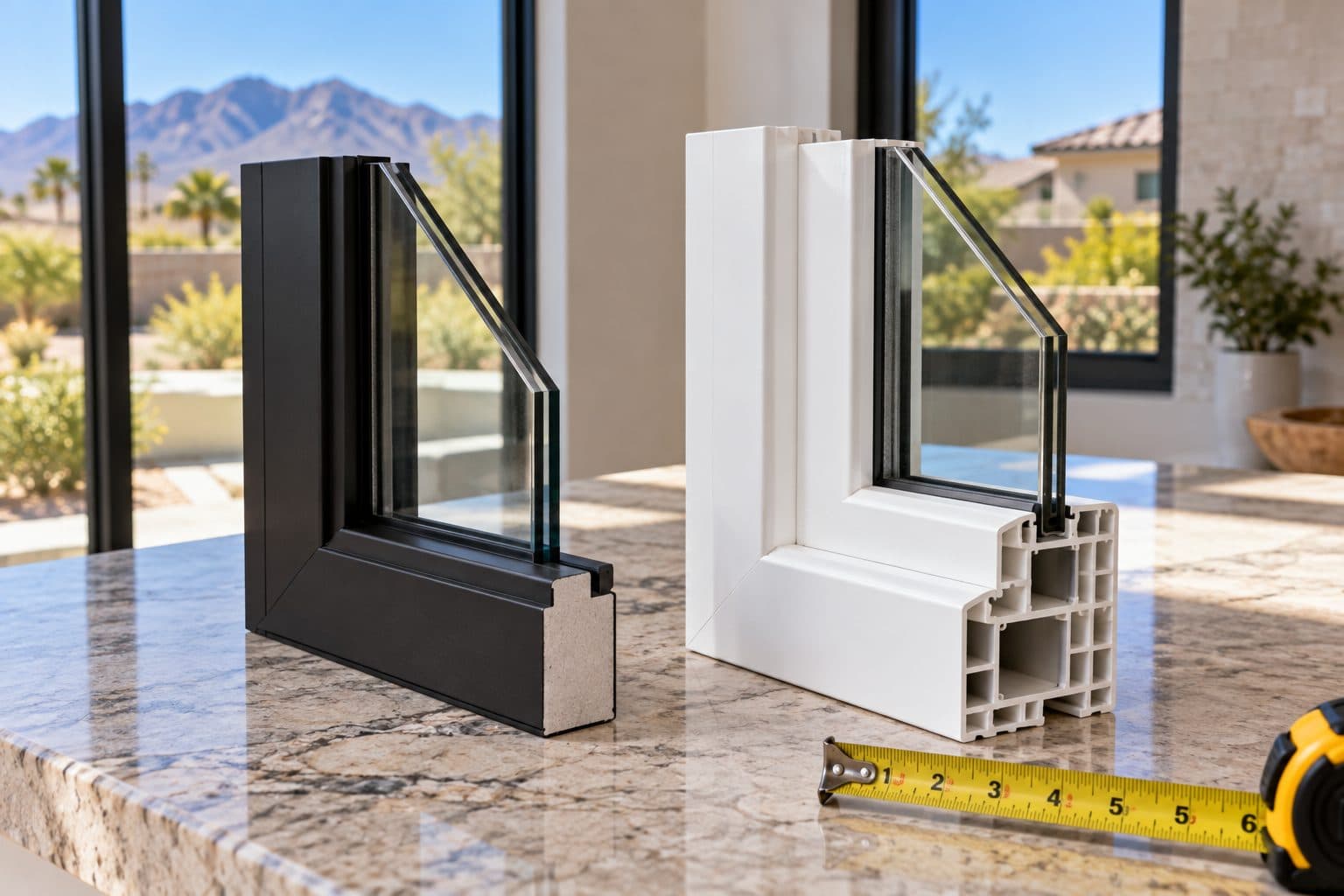
Neither fiberglass nor vinyl wins in every home. Fiberglass is stiffer and vinyl is widely available, but heat performance depends on the whole-window ratings, so compare two specific quoted windows that share size and glass.
On this page
Know what the material names mean
Vinyl window framing uses a formulated PVC-based material. Fiberglass framing combines glass fibers and resin. Manufacturers develop their own profiles, reinforcement and finishes, so products within either category can differ noticeably.
The Pella material overview separates vinyl and fiberglass as product categories. The Milgard fiberglass overview describes its own fiberglass construction. Use each source to understand its described construction, then verify the specifications of the actual candidates.
Also be careful with the broader word composite. Fiberglass is a composite, but other proprietary composites can have different ingredients. Ask for the actual frame construction rather than grouping every nonmetal option together. If a metal frame is also on your list, see vinyl compared with aluminum windows.
Compare the evidence that affects the finished opening
| What matters to you | What to compare in fiberglass and vinyl |
|---|---|
| More visible glass | Finished glass dimensions and actual frame/sash profiles |
| A dark exterior | Available factory finish, approved application and finish coverage |
| Strong sun exposure | Whole-product SHGC, U-factor and daylight characteristics |
| A large opening | Supported product dimensions, glass and joining requirements |
| Simple care | Actual cleaning instructions and operating-hardware maintenance |
| Long-term support | Product identification, warranty terms and responsibility for service |
| Budget | Equivalent product and installation scopes in written quotes |
This table avoids assigning a universal winner because the decision depends on the proposed assemblies. A material may open a useful design option, but the product documentation must show that the option is available for your project.
Start with frame profile and appearance
If the main goal is a different visual outline, request elevations at the actual dimensions. Compare the perimeter frame, operating sash, meeting rail or stile and any joined members. Do not infer a slimmer frame from the material name alone.
Visible glass also depends on installation. A replacement that retains an existing frame may show a different total border from one that removes it. Comparing only the new product cross-section can miss the result you will see in the room.
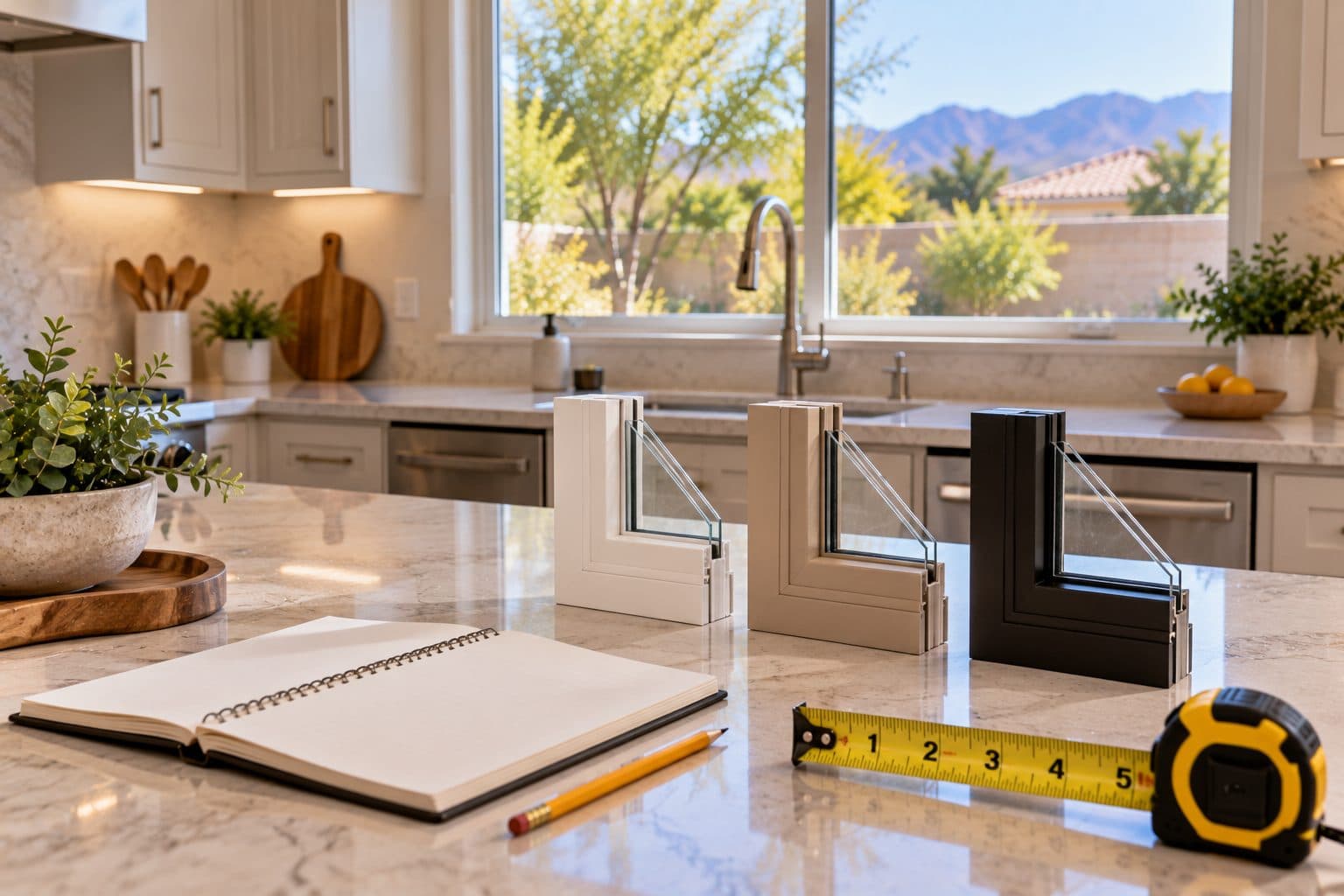
Review color, texture and sheen on physical samples where possible. Ask which interior and exterior combinations are available in each candidate. A preferred finish may be offered on one style or series but not another. The real catalog can narrow the material decision more usefully than an abstract list of advantages. For dark colors, see our guide to black window frames in Las Vegas heat.
Put heat claims beside whole-window ratings
U-factor
How easily heat passes through the whole window. Lower keeps more heat out in summer and in during winter.
SHGC
Solar heat gain coefficient: how much of the sun's heat comes through. Lower means less heat from direct sun.
VT
Visible transmittance: how much daylight comes through. Higher means a brighter room.
A material discussion often becomes a shortcut to calling one window best for a hot climate. That skips the rest of the assembly. Glass, spacers, seals, frame design and operating configuration all contribute to the documented result.
Compare whole-product U-factor and solar heat gain coefficient for the candidates. Review visible transmittance when preserving daylight matters. If two quotes use different glass packages, identify that difference before attributing the rating change to fiberglass or vinyl.
ENERGY STAR certification is also product- and configuration-dependent. The applicable climate criteria and actual selection need checking. A frame material or a manufacturer's program participation does not establish that every proposed unit is certified for the project.
For a Las Vegas room with direct afternoon sun, describe the timing, shading and seating location. Those details help identify what the glass should address. The material choice should support the room goal without replacing it.
how we install
The Part Behind the Glass

Measured before anything is ordered
Flashed so water has a way out
Read strength and durability claims carefully
A manufacturer may describe a material test, a frame-component test or a whole-product test. Those are different claims. A stronger test specimen does not automatically prove that every finished window can be built larger or will last a particular number of years.
If size is the reason you are considering fiberglass windows, ask for the approved dimensions and construction of the actual line. If a vinyl option meets the same opening needs, compare the rest of the specifications rather than assuming the material ends the discussion.
Avoid unsupported lifespan predictions. Installation, exposure, components, care and product quality all matter. Written coverage and accessible product documentation are more useful purchase inputs than a generic promise that one category lasts forever.
Compare care and future color changes
Both categories can offer a manageable maintenance routine, but neither makes glass, seals, screens and operating hardware maintenance-free. A slider still needs track care; a hinged unit still has operators and seals; a lifting unit still has moving components.
Read the instructions for the selected finish. Some fiberglass products allow painting under specified conditions. That does not mean every factory finish accepts any paint. Vinyl products also have manufacturer-specific restrictions on coatings and modifications. Do not plan a future color change without checking what the actual product permits.
Ask how to identify the unit if a component needs attention later. A product label and clear order record help with parts questions. Material appearance alone is not enough to specify a replacement lock, balance, screen or glass unit.
Compare warranties without using a single headline
Separate frame, finish, glass and hardware coverage. Check exclusions, transfer conditions and any maintenance or registration requirements in the actual documents. A broad warranty headline may hide different terms for different components, as our guide to reading window warranties explains.
Installation labor needs its own explanation. Identify who handles a product claim and who addresses an installation issue. The material category does not tell you whether service labor, removal, finishing or other costs are included.
If you expect to add tint, repaint or modify the window, raise that intention before approval. The warranty and manufacturer instructions should be reviewed for the specific change. That can affect the usefulness of a product even when its initial appearance is ideal.
Compare materials in two passes
First compare the candidates against the same requirements: opening dimensions, operating function, desired appearance, glass goals and finished installation scope. This pass prevents a difference in removal method or glazing from being mistaken for a difference caused by frame material.
Then compare the actual combinations you can buy. Exact parity may not be available. One line may support a preferred finish or profile that another does not; one may require a different installation approach. Keep those differences visible rather than forcing an artificial claim that the offers are identical.
| Difference between the quotes | How to classify it | How to decide |
|---|---|---|
| Different glass package | Assembly-performance difference | Compare ratings and appearance against the room goal |
| Different retained-frame treatment | Installation-scope difference | Compare finished border, access and repair scope |
| Different factory finish | Available design option | Check whether the actual color and care matter to you |
| Different claimed strength | Evidence question | Identify test scope and practical benefit at your size |
| Different total price | Combined product and work difference | Align scope, then value the remaining benefits |
For a hypothetical front elevation, the fiberglass candidate offers the preferred documented profile and finish, while the vinyl candidate satisfies the same operating and thermal needs with a different border. If that appearance difference matters enough to the homeowner, it is a defensible reason to choose the first candidate. It is not proof that its material improves every opening in the house.
In another hypothetical comparison, both products satisfy the important requirements, but one quote includes perimeter finish restoration and the other leaves it excluded. Resolve the missing work before comparing totals. Otherwise the apparent material saving is partly an unfinished-scope difference.
Use actual written proposals for price. National averages and generic percentage premiums cannot establish what these two complete selections cost for your opening.
Decide what evidence would change your preference
Before comparing brochures, write down the strongest reason you currently favor one material. Then name the evidence that would confirm or weaken that reason. This keeps the comparison focused on a useful outcome.
If you want more visible glass, the deciding evidence is the finished elevation and glass dimensions. If you want a future color change, the deciding evidence is the selected finish's written refinishing instructions. If you want a large configuration, the deciding evidence is the supported product size and relevant project review.
A material test can explain a manufacturer's design choices without proving all those outcomes. FGIA's performance-class guidance addresses complete-product performance; it serves a different purpose from a raw-material strength comparison. Keep the test boundary attached to the claim.
If the evidence does not support your original reason, change the preference. If it does, carry that specific benefit into the final decision record. The objective is to select a window whose documented differences serve the room, not to defend an initial material assumption.
Make the final choice about the product you will receive
Create a short comparison record with the exact product name, operating style, dimensions, glass, finish, ratings, care requirements, coverage and installed scope. Mark any unanswered item rather than filling it with a category assumption. Our complete window buying guide lists the other decisions to record.
Choose the option whose documented differences matter to you. If the products meet the same needs, price and written support terms can guide the decision. If one supports a design the other cannot, make that specific benefit clear before committing to it.
This guide supports
Replacement Windows →things people ask us
Frequently Asked Questions
Is fiberglass always better than vinyl in Las Vegas heat?
No universal conclusion follows from the material. Compare the exact whole-window ratings, available finish, supported application and installation details. The room’s exposure and the selected glass package are central to a useful thermal decision.
Will fiberglass always give me a thinner frame?
Not necessarily. Compare the actual frame, sash and joining profiles at the required size. A specific fiberglass product may offer a profile you prefer, but another configuration can have different visible dimensions. The installation method also affects the total border.
Which material costs less?
Use equivalent installed quotes for the actual products, and ask for a written estimate that prices both. Frame category is only one input; glass, size, finish, operation and construction scope can change the result. Do not apply a generic percentage difference to a project without a defensible local quote basis.
Can both materials be used in the same house?
A mixed selection can be considered if the products suit their openings and the visible design is coordinated. Compare profiles, colors, glass appearance and service documentation. Matching color names alone does not guarantee that different lines will look identical.
What should I ask when a salesperson says one material is stronger?
Ask what was tested, which products were compared and what that result changes for your opening. A raw-material test is different from a complete-window rating. The claim should connect to a practical, documented benefit at the proposed size and configuration.
What if the fiberglass and vinyl offers cannot be made identical?
Compare both against the same requirements, then record the real differences in available finishes, profiles, glazing and installation. Decide whether those differences matter enough to change your choice. Exact parity is not required, but the differences should not be hidden inside a material-only verdict.
Still have a question about your home?
Ask us directly. A quick description of the opening is enough.
keep going
Related Services and Guides
- Replacement Windows
Replacement windows in Las Vegas, planned room by room. See how to choose glass, frames and installation method, and what a clear estimate should include.
- Fiberglass windows
Fiberglass windows in Las Vegas: what the frames are made of, finish and color options, and how to compare them with vinyl using whole-window ratings.
- Vinyl windows
Vinyl windows in Las Vegas need little upkeep and come in many styles. Learn how frame thickness, glass and color options differ before you compare quotes.
- Window buying guide
How to choose replacement windows in Las Vegas: list what each room needs, pick a style, compare glass ratings and installation, then line up quotes.
- Window energy ratings
U-factor and SHGC explained in plain terms: what each window energy rating measures, how to read an NFRC label, and which numbers to compare on a quote.
- Window warranty guide
How to read a window warranty: what is covered, who pays for labor, what lifetime really means, whether it transfers, and which records you should keep.
- Vinyl vs Aluminum Windows
Vinyl vs aluminum windows for Las Vegas homes: compare insulation, frame width, colors, upkeep and energy ratings to see which suits your house.
- Single-Hung vs Double-Hung
Single-hung vs double-hung windows: which sashes move, how each is cleaned, how much they open, and when the extra function is worth choosing.
- Sliding vs Casement Windows
Sliding vs casement windows: how each opens, the space each needs outside, which is easier to reach and clean, and how to choose one for each room.
Sources referenced on this page
Independent references linked in the text above. A manufacturer source explains a product concept; it does not mean Agave Windows supplies that brand.
- Pella material overview (pella.com)
- Milgard fiberglass overview (milgard.com)
- FGIA's performance-class guidance (fgiaonline.org)

ready when you are
Have a Question About Your Own Home?
A guide can explain the choice. Your openings decide the answer. Tell us what you are seeing and we will help you work out the next step.
- Photos can follow once we reply; no measurements needed
- A written scope before anything is ordered
- Licensed, insured, and bonded
Request an Estimate